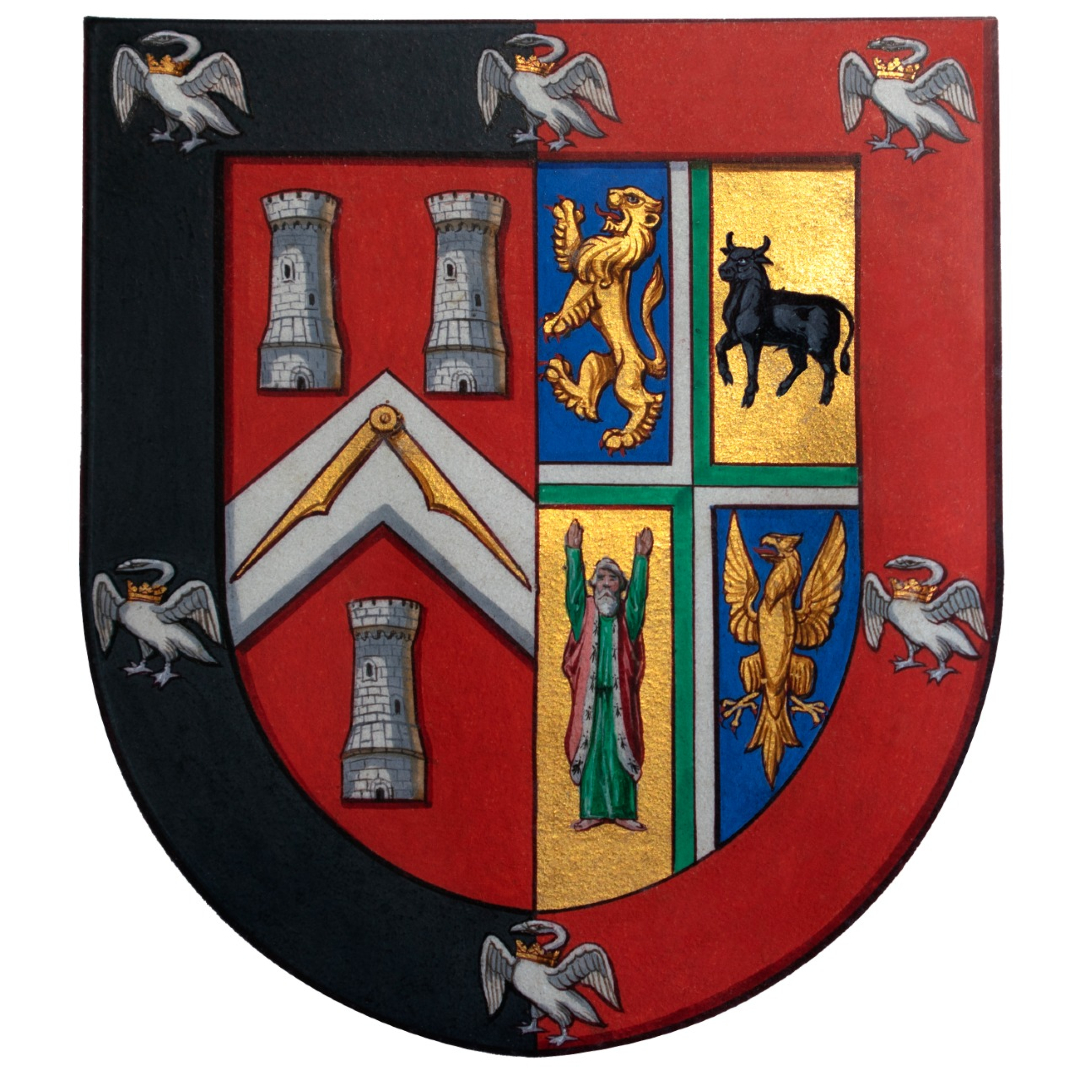
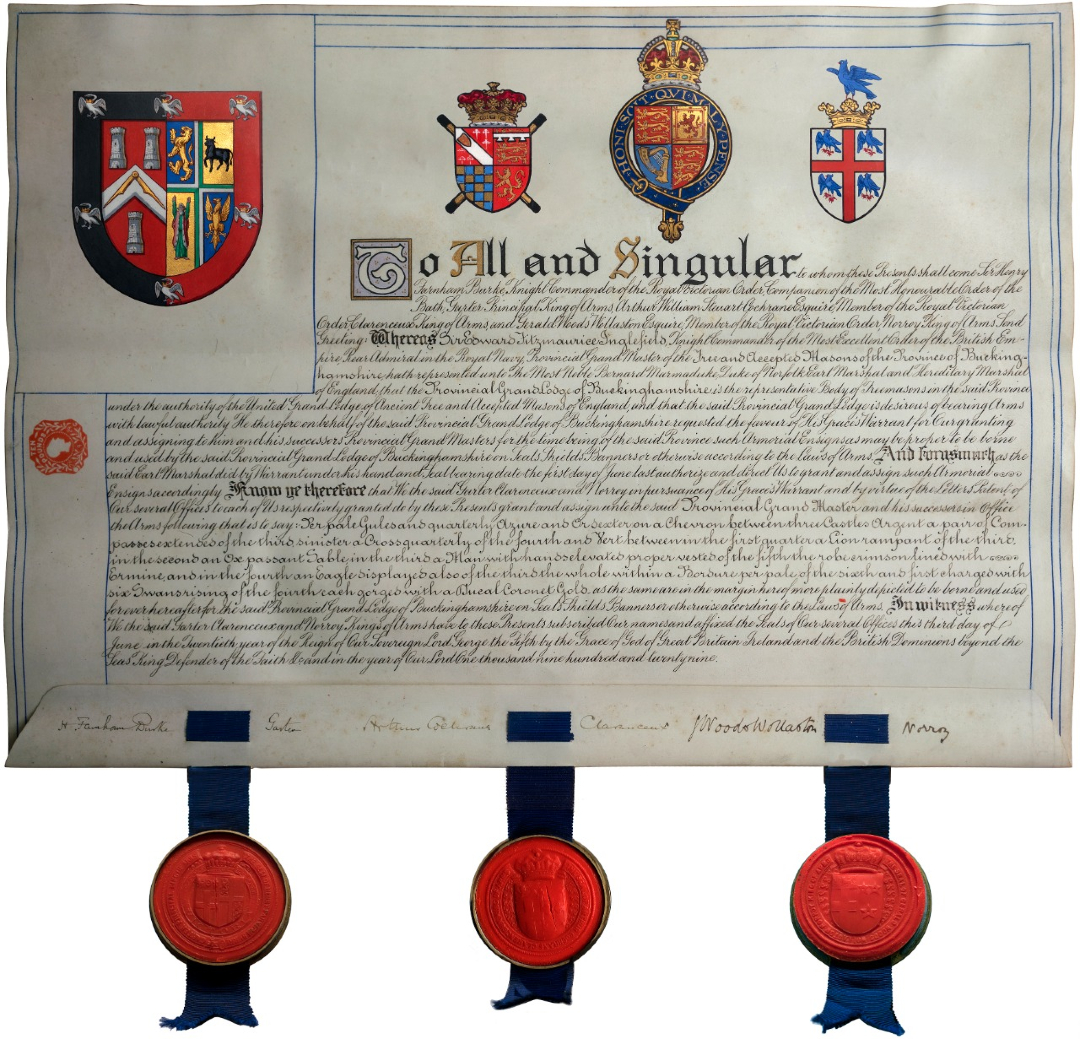
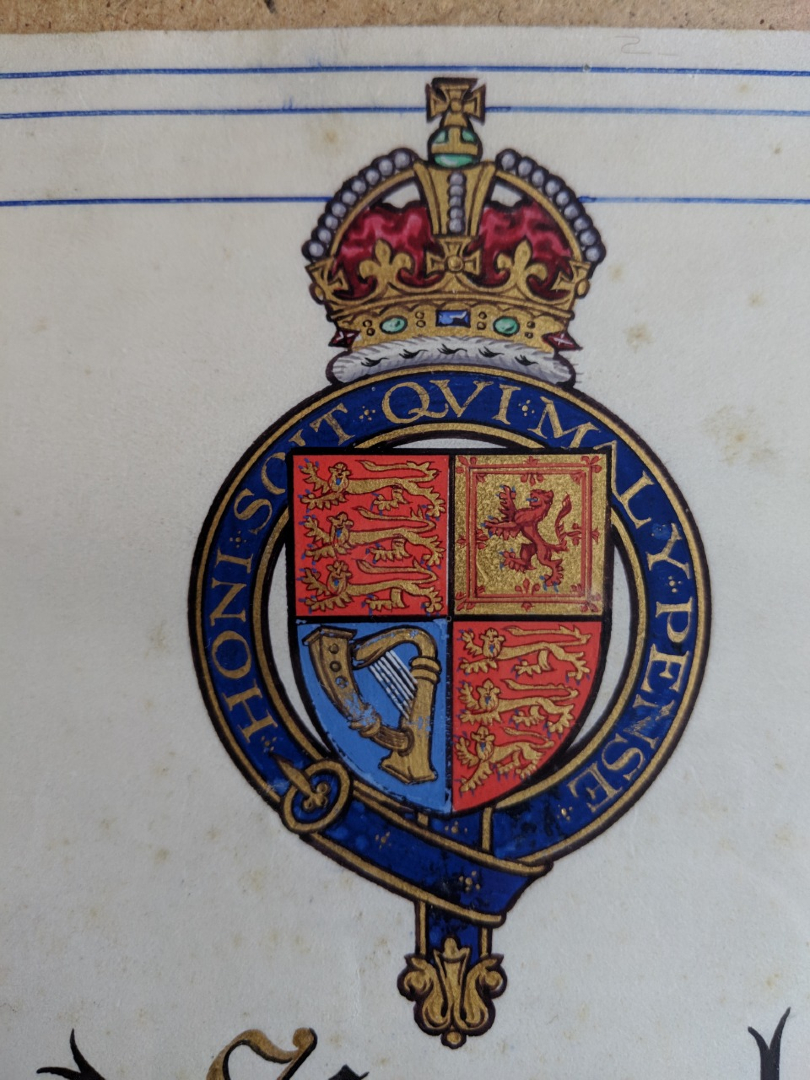
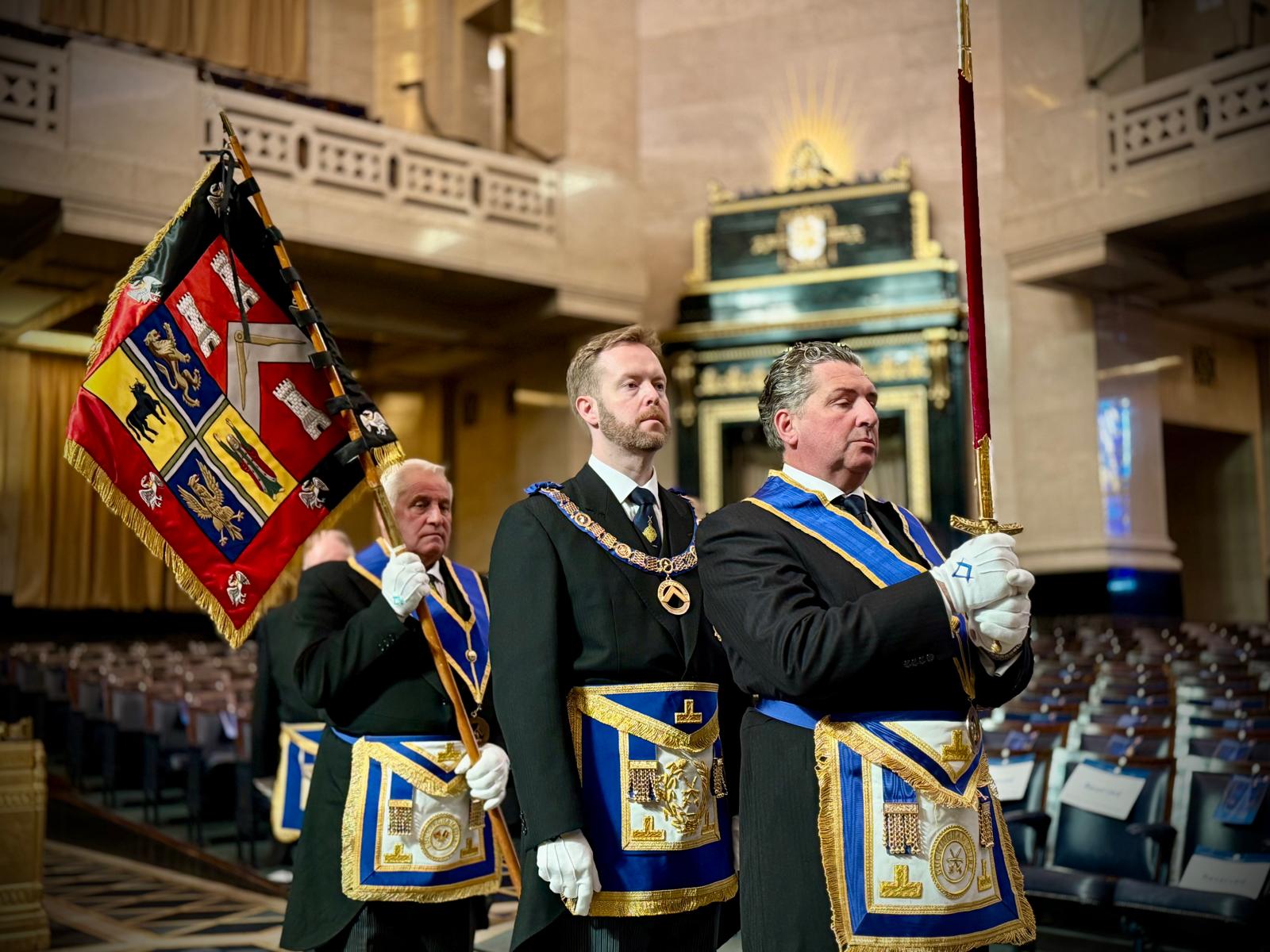
This is the 1929 Grant of Arms, and Heraldic Shield for the Province of Buckinghamshire, issued by the College of Arms and painstakingly hand-painted, gilded, inscribed and wax sealed. The College maintains an ancient English tradition of manuscript writing and illumination which can be traced back to the monastic scriptoria of the dark ages.
Every Province has its own Grant of Arms and Heraldic Shield, and each one is as distinct and wonderfully decorated as ours
The full text on the warrant reads as follows:
"To All and Singular to whom these Presents shale come
Sir Henry Farnham Burke Knight Commander of the Royal Victorian Order, Companion of the Most Honourable Order of the Bath, Garter Principal King of Arms, Arthur William Stuart Cochrane Esquire, Member of the Royal Victorian Order, Clarenceux King of Arms, and Gerald Woods Wollaston Esquire, Member of the Royal Victorian Order, Norroy King of Arms Send Greetings:
Whereas Sir Edward Fitzmaurice Inglefield, Knight Commander of the Most Excellent Order of the British Empire, Rear Admiral in the Royal Navy, Provincial Grand Master of the Free and Accepted Masons of the Province of Buckinghamshire hath represented unto the Most Noble Bernard Marmaduke, Duke of Norfolk Earl Marshal and Hereditary Marshal of England that the Provincial Grand Lodge of Buckinghamshire is the representative Body of Freemasons in the said Province under the authority of the United Grand Lodge of Ancient and Accepted Masons of England and that the said Provincial Grand Lodge is desirous of bearing Arms with lawful authority He therefore on behalf of the said Provincial Grand Lodge of Buckinghamshire requested the favour of His Grace’s Warrant for Outgranting and assigning to him and his successors Provincial Grand Masters for the time being of the said Province such Armorial Ensigns as may be proper to be borne and used by the said Provincial Grand Lodges of Buckinghamshire on Seals Shields Banners or otherwise according to the Laws of Arms. And Forasmuch as the said Earl Marshal did by Warrant under his hand and Seal bearing date the first date of June last authorise and direct Us to grant and assign such armorial Ensign accordingly. Know ye therefore that We the said Garter Clarenceaux and Norroy in the pursuance of His Grace’s Warrant and by virtue of the Letters Patent of Our several Offices to each of U s respectively granted do by these Presents grant and assign unto the said Provincial Grand Master and his successors in Office the Arms following that is to say:
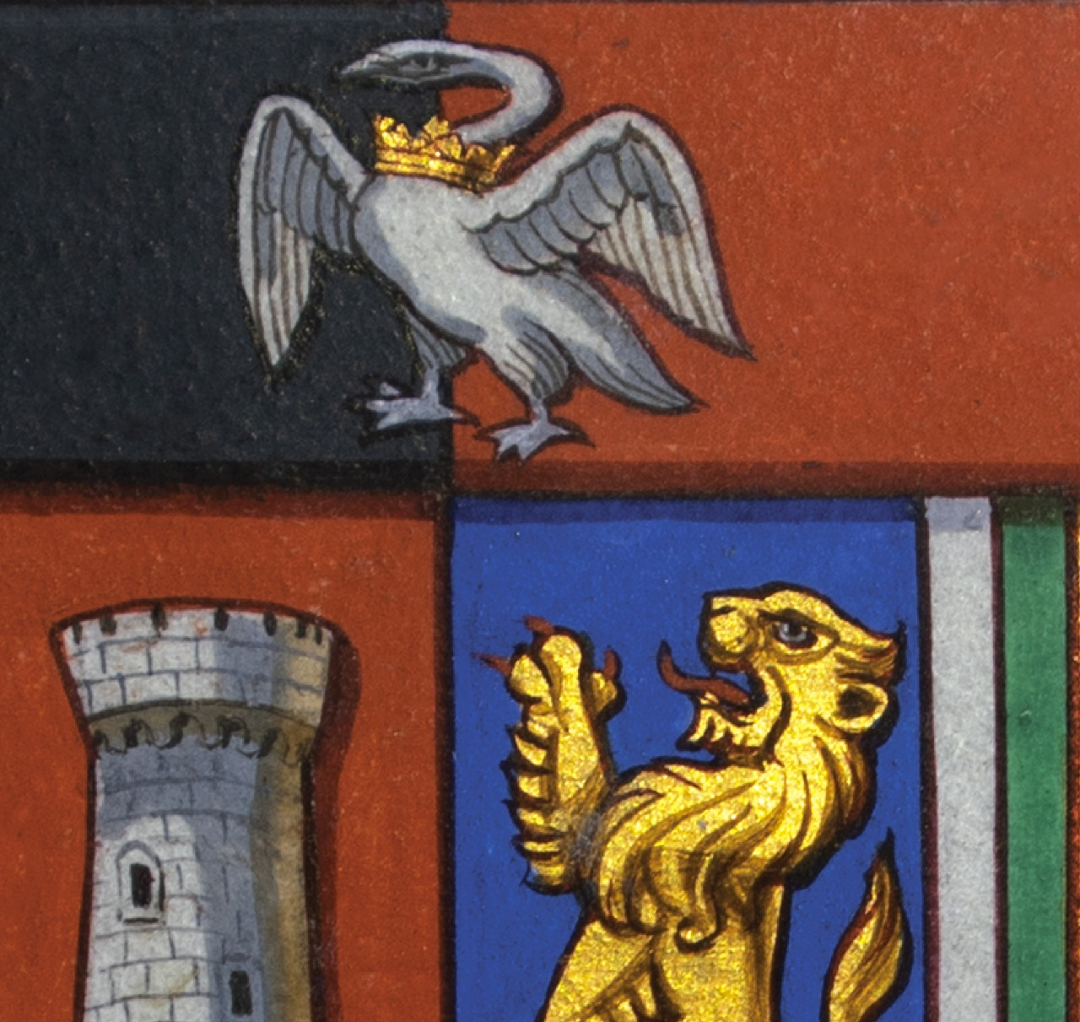
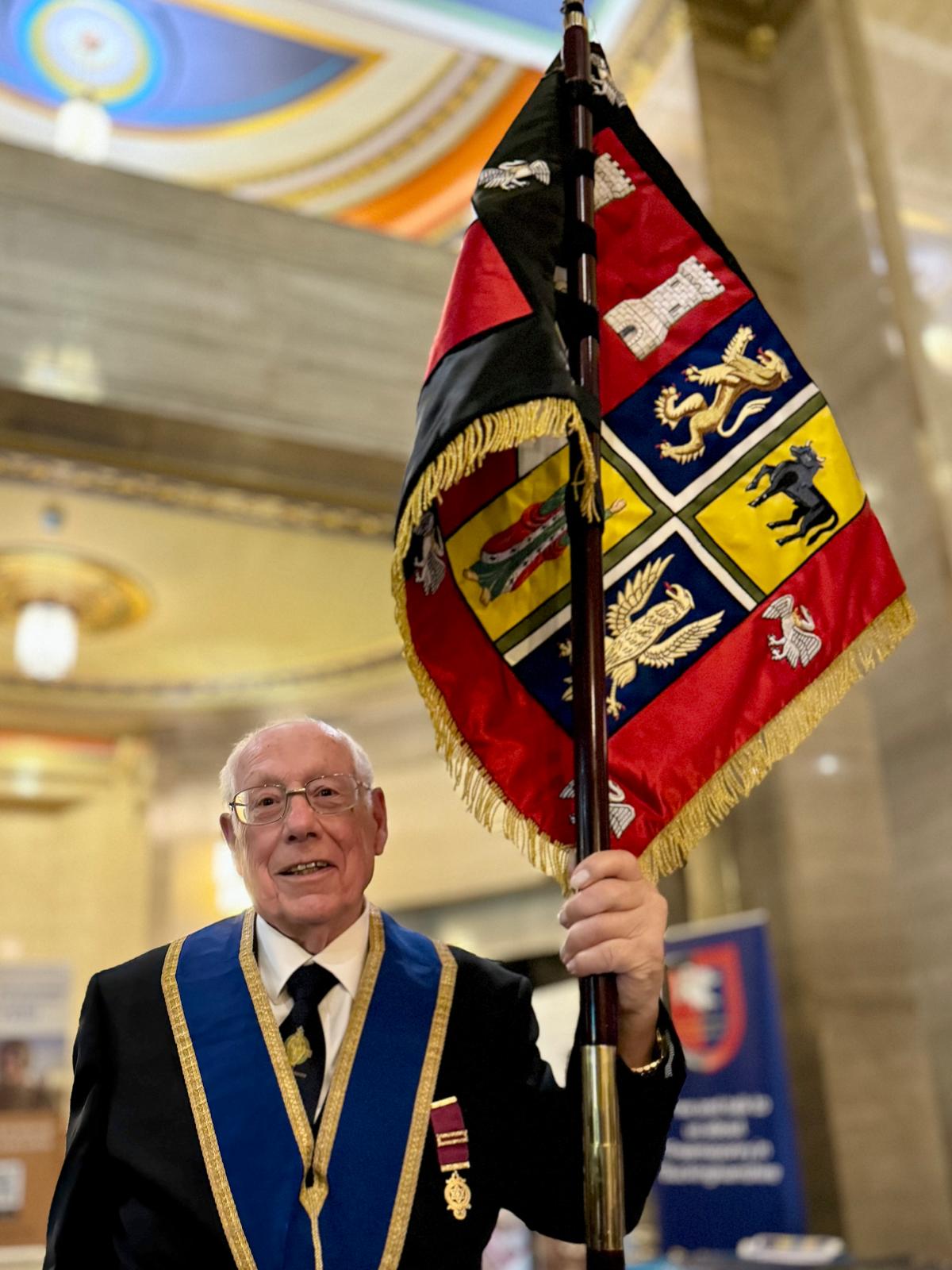
Per pale Gules and quarterly Azure and Or dexter on a Chevron between three Castles Argent a pair of Compasses extended of the third sinister a Cross quarterly of the fourth and Vert between in the first quarter a Lion rampant of the third, in the second and Ox passant Sable in the third of a Man with hands elevated proper vested of the fifth the robe crimson lined with Ermine, and in the fourth an Eagle displayed also of the third the whole within a Bordure per pale of the sixth and first charged with six Swans rising of the fourth each gorged with a Ducal Coronet Gold as the same are in the margin here of more plainly depicted to be borne and used forever hereafter for the said Provincial Grand Lodge of Buckinghamshire on Seals Shields Banners or otherwise accordingly to the Laws of Arms.
In witness whereof We the said Garter Clarenceaux and Norroy Kings of Arms have to these Presents subscribed Our names and affixed the Seals of Our several Offices this third day of June in the Twentieth year of the reign of Our Sovereign Lord George the Fifth by the Grace of God of Great Britain and Ireland and the British Dominions beyond the Seas King Defender of the Faith & and in the year of Our Lord One thousand nine hundred and twenty nine."
Every Province has its own Grant of Arms and Heraldic Shield, and each one is as distinct and wonderfully decorated as ours
The full text on the warrant reads as follows:
"To All and Singular to whom these Presents shale come
Sir Henry Farnham Burke Knight Commander of the Royal Victorian Order, Companion of the Most Honourable Order of the Bath, Garter Principal King of Arms, Arthur William Stuart Cochrane Esquire, Member of the Royal Victorian Order, Clarenceux King of Arms, and Gerald Woods Wollaston Esquire, Member of the Royal Victorian Order, Norroy King of Arms Send Greetings:
Whereas Sir Edward Fitzmaurice Inglefield, Knight Commander of the Most Excellent Order of the British Empire, Rear Admiral in the Royal Navy, Provincial Grand Master of the Free and Accepted Masons of the Province of Buckinghamshire hath represented unto the Most Noble Bernard Marmaduke, Duke of Norfolk Earl Marshal and Hereditary Marshal of England that the Provincial Grand Lodge of Buckinghamshire is the representative Body of Freemasons in the said Province under the authority of the United Grand Lodge of Ancient and Accepted Masons of England and that the said Provincial Grand Lodge is desirous of bearing Arms with lawful authority He therefore on behalf of the said Provincial Grand Lodge of Buckinghamshire requested the favour of His Grace’s Warrant for Outgranting and assigning to him and his successors Provincial Grand Masters for the time being of the said Province such Armorial Ensigns as may be proper to be borne and used by the said Provincial Grand Lodges of Buckinghamshire on Seals Shields Banners or otherwise according to the Laws of Arms. And Forasmuch as the said Earl Marshal did by Warrant under his hand and Seal bearing date the first date of June last authorise and direct Us to grant and assign such armorial Ensign accordingly. Know ye therefore that We the said Garter Clarenceaux and Norroy in the pursuance of His Grace’s Warrant and by virtue of the Letters Patent of Our several Offices to each of U s respectively granted do by these Presents grant and assign unto the said Provincial Grand Master and his successors in Office the Arms following that is to say:
Per pale Gules and quarterly Azure and Or dexter on a Chevron between three Castles Argent a pair of Compasses extended of the third sinister a Cross quarterly of the fourth and Vert between in the first quarter a Lion rampant of the third, in the second and Ox passant Sable in the third of a Man with hands elevated proper vested of the fifth the robe crimson lined with Ermine, and in the fourth an Eagle displayed also of the third the whole within a Bordure per pale of the sixth and first charged with six Swans rising of the fourth each gorged with a Ducal Coronet Gold as the same are in the margin here of more plainly depicted to be borne and used forever hereafter for the said Provincial Grand Lodge of Buckinghamshire on Seals Shields Banners or otherwise accordingly to the Laws of Arms.
In witness whereof We the said Garter Clarenceaux and Norroy Kings of Arms have to these Presents subscribed Our names and affixed the Seals of Our several Offices this third day of June in the Twentieth year of the reign of Our Sovereign Lord George the Fifth by the Grace of God of Great Britain and Ireland and the British Dominions beyond the Seas King Defender of the Faith & and in the year of Our Lord One thousand nine hundred and twenty nine."